
THE REBIRTH AND RESILIENCE OF NEW YORK CITY
The decade began with the aftermath of the September 11 attacks on the World Trade Center. Though this tragic event cast a shadow over the city's history, they also showcased New York's remarkable resilience, leading to a period of rebirth. With a strong rebound of the economy, neighborhoods in Brooklyn transformed, crime rate continued to drop and opportunities grew as the city adapted to new challenge.
Wall Street, Manhattan
Street in the city's financial district that has become symbol for the US economy in film and other media.
Upper West Side
Considered 'Uptown' for New Yorkers (along with Midtown and Upper East Side); a Manhattan area that has benefited the most from the economic growth.
Cover photo: 25th Hour (2002)
With Michael Bloomberg as mayor, the city remained progressive and continued initiatives to improve quality of life. Besides long awaited improvements in transportation and sustainability, it also meant continued support to initiatives that contributed to New York as a global city. Including supporting the city's film industry in its rebound after 9/11.
In light to this tragic recent event, film makers explored themes around the 9/11 events. Documentary and non-fiction films became more common. With films such as Fahrenheit 9/11 (2004) and World Trade Center (2006), film makers narrowed in on the actual events, while with drama films such as 25th Hour (2002) and Remember Me (2010) film makers touched upon 9/11 in a more subtle tone.
Initially, the disruptive event of 9/11 negatively affected the economy, but forced new standards in real estate in favor of many investors. As a result, the real estate market started to flourish and many new areas experienced deeper gentrification, with neighborhoods like Williamsburg in Brooklyn undergoing significant transformation.
This specific neighborhood in Brooklyn, was known to be an industrial and working-class neighborhood. Such neighborhoods hosted many artists as the neighborhoods offered plenty of loft spaces and industrial buildings that could be converted to live-work spaces for artists. While these initiatives by artists contributed to the groundwork for the neighborhood’s transformation, the culture of this and many other areas have completely shifted since the city’s rebirth of the 2000’s.
Other neighborhoods, such as TriBeCa in Manhattan and DUMBO in Brooklyn, experienced a very similar rebirth. Many of the films which I have covered in previous decades were shot in these neighborhood. Such as Serpico (1973), The Warriors (1979), and Men In Black (1997).

Robert Pattinson in Remember Me (2010).
The World Trade Center in the background during a scene in Serpico (1973)

The World Trade Center in the background during a scene in When Harry Met Sally (1989)

A source for film inspiration
NEW YORK IN DYSTOPIAN SETTINGS
The events around the September 11th attacks brought moments of crisis and emotional devastation to the city. This became an inspiration for a sub-genre of post-apocalyptic and disaster films in New York. Films like I Am Legend (2007) and Cloverfield (2008) echoed the anxieties in the 9/11 aftermath.
The films in this sub-genres resonate with many psychological and visual aspects of the 9/11 aftermath, without directly reflecting the events themselves. For instance, in I am Legend, Will Smith plays the character of a seemingly lone survivor in a post-apocalyptic New York. Visually we see a city in ruins with deconstruction and chaos. The skyline is altered, as nature and wildlife reclaimed the buildings and streets.
This doesn't comment on 9/11, but it does echo the altered skyline after the loss of the Twin Towers, which were so defining for the visual representation of New York. Even so much so, that films such as Dog Day Afternoon (1975), Manhattan (1979), The Bonfires Of The Vanities (1990), and many more, used the Twin Towers as the establishing shot to introduce the setting of New York in films.


The 2008 film Cloverfield also showed strong thematic similarities with the events of of 9/11. The film is entirely presented in a "found footage" format, with footage from characters who documented the events of a catastrophic day in New York. This technique gives the viewing experience a sense of realism and urgency, similar to the footage from eyewitnesses during the day of 9/11.
More similarities can be observed in movies like Vanilla Sky (2001), where the character portrayed by Tom Cruise navigates a bewildering and surreal urban environment. Additionally, The Day After Tomorrow (2004) and War of the Worlds (2005), both partially filmed in New York City, share thematic elements with the events of 9/11.
SoHo, Manhattan
Neighborhood south from the "expensive" uptown area which was known for fostering fashion designers, visual artists and trendy stores.
East Village, Manhattan
South from uptown area. Known for its art galleries and music scene.

2000 – 2009

2010's hits


2000's hits


1970 – 1980

1/3
Robert De Niro is 1 of 3 founders of the Tribeca Festival (with Jane Rosenthal, and Craig Hatkoff)
14
Ranked #14 on Barron's Top 25 Philanthropists Of The World for for helping revive the city with the TriBeCa festival
In response to the initial economic and cultural challenges after the September 11 attacks, Robert De Niro, Jane Rosenthal, and Craig Hatkoff founded a festival to revitalize the TriBeCa neighborhood in Manhattan. The Tribeca Festival not only provided a platform for independent filmmakers and fostered talent but also played a pivotal role in the rebirth of the city's cultural vibrancy and its status as a filmmaking hub.

2008
Man On Wire
A documentary that chronicles Philippe Petit's high-wire walk between the Twin Towers of the World Trade Center in 1974.
World Trade Center, Manhattan
2011
Detachment
This film explores the challenges faced by a substitute teacher (Adrien Brody) in a troubled urban school.

2019
The Farewell
The story follows a Chinese-American young woman who finds herself navigating cultural differences and a terminal diagnosis of her grandmother.

2020
The King Of Staten Island
Don Johnston receives an anonymous letter from a former lover informing him that he has a son who may be looking for him.

With just a 10 minute walk north off the World Trade Center you will find the neighborhood of TriBeCa. A Lower Manhattan neighborhood which was known for its industrial character with many loft buildings that were commonly resided by artists. De Niro (actor), Rosenthal (film producer) and Hatkoff (real estate investor), have been residents of this neighborhood since before 9/11. And so, they have experienced the devastating impact on the vibrant culture and economy in their neighborhood which inspired them to work together in starting the Tribeca Festival (formerly named Tribeca Film Festival).
The first TriBeCa Festival took place in may 2002 and contained (short) films, independent feature films and family friendly screenings. It was attended by 150.000 people, making it an instant success in its mission to revive the neighborhood. Since then, the annual film festival grew in popularity and expanded its screening to other parts of Manhattan and greater New York City.
As an example of the impact on the neighborhood; De Niro had purchased a theatre in the neighborhood, which was known for screening independent film. The theatre was renamed the Tribeca Cinema and is now used as one of the venues for the festival.
Over the years, the festival gained global popularity by premiering thousands of films such as, Man On Wire (2008), Detachment (2011) and This Is Where I Leave You (2014).
Today, the TriBeCa Festival continues to recognize independent film and talent with screenings and awards in 23 different categories. In additional to film, the festival hosts talks by influential speakers such as Steven Spielberg, Martin Scorsese, Ron Howard, Spike Lee, Meryl Streep and many more. The festival also shows other forms of storytelling, including games and music.
In 2009, Barron's (a magazine/newspaper by Dow Jones & Company), named De Niro, Rosenthal and Hatkoff in its list of Worlds 25 Best Givers. Ranked at number 14 for their highly successful contribution in the economic recovery of TriBeCa after 9/11.
Notable films that premiered at the TriBeCa Festival
Man On Wire
A documentary that chronicles Philippe Petit's high-wire walk between the Twin Towers of the World Trade Center in 1974.
World Trade Center, Manhattan
2019
The Farewell
The story of a Chinese-American young woman navigating cultural differences and a terminal diagnosis of her grandmother.
2011
Detachment
This film explores the challenges faced by a substitute teacher (Adrien Brody) in a troubled urban school.
2020
The King Of Staten Island
Don Johnston receives an anonymous letter from a former lover informing him that he has a son who may be looking for him.
THE TRIBECA FESTIVAL, FOUNDED TO SPUR THE REBIRTH OF FILM IN NYC
2000 – 2009

25TH HOUR

2002
Highlighted film
One of the earliest post-9/11 films reflects Spike Lee's decision to subtly embrace, rather than avoid, the tragedy's impact on New York City. This made 25th Hour a memorable film with a timestamp. "The backdrop of 9/11 was something that we felt like could help tell the story," said Lee.
The film's intro sequence focuses entirely on a new skyline, dominated by the beams of light from Ground Zero. But despite this intro, 9/11 is subtly woven in the narrative. It follows Monty Morgan (Edward Norton), who is facing a prison sentence as he is charged with drug related crimes. He uses his last 24 hours of freedom before prison to reflect on his choices, which leads to tensions with the city and the people around him.
Spike Lee, known for his ability to depict socio-economical tensions, uses this premise to show the pulse of New York City and its people in an environment that copes with the repercussions of the terrorists attacks. This includes characters that vividly display the distinctive attitude of New Yorkers. Lee also highlights the city's multicultural society, particularly in an intense monologue of Ed Norton's character while talking to a mirror that has the words "Fuck you!" written on it.
With his deep love for the city, Spike Lee goes beyond the theme of 9/11 and captured the cultural, social, and emotional fabric of the city as it existed on the day of the film's release.

Lights from Ground Zero and the Statue Of Liberty.

Lights from Ground Zero and the Brooklyn Bridge.
A CRIME DRAMA THAT MARKS SPIKE LEE'S CHECKLIST
Much like many of Lee's other movies, the film tells a seemingly simple narrative, while it carries deeper layers on subjects around New York City, its multicultural population, social issues and identity. These themes, along with signature direction in camera and editing methods, make this a authentic Spike Lee - "40 Acres And A Mule" - production.
Shots that represent some of New York's demographics that were mentioned in the monologue.

Monty (Ed Norton) ranting about New Yorkers while looking in a mirror with the words "Fuck you" on it.

Racial and social groups in New York ✔
Likely the most common theme in Spike Lee films is the exploration of racial and social issues as shown In films such as Do The Right Thing (which I cover in 1980-1989). The most prominent example of this in 25th Hour is Monty's (Ed Norton) monologue in a bathroom mirror. The "Fuck you" monologue is a intense rant in which he blames every demographic in New Yorkers from, Afro American, Sikh, Korean, Gay, poor, rich to even his own family. It eventually resolves in Monty admitting the blame of his mess to no one but himself.


The use of double dolly shots ✔
Occasionally in Lee's films, he breaks the fourth wall and uses techniques to bring characters closer to the viewer. One of the ways Lee is doing this is by using compelling double dolly shots in which camera and actor are gliding forward simultaneously. This creates an intimate illusion between the character and the viewer. In 25th Hour this happens three times.

Monty and his friends inside of a nightclub.
"25th Hour is an underrated Spike Lee Joint."
@twocents6951 (Youtube comment, 3 years ago)
Music integrated in the story like a character ✔
A recurring element to set the tone in Lee's film is the strategic use of music. For instance, In Do The Right Thing (1989), Lee created an opening scene with someone dancing to Public Enemy's Fight The Power. A song created to reflect themes of the film. In Mo' Better Blues (1990) we follow a trumpeter through jazz clubs in New York, offering viewers a glimpse of this culture. Examples like these made Lee famous for using music as more than background, but rather as an integral part of the narrative. In 25th Hour, music is used to bring a stark contrast between moments of escaping reality inside of a nightclub and the bleak realities outside of it.
MONTY'S FURRY FRIEND, A METAPHOR FOR NEW YORK'S RECOVERY
Monty had found his dog, Doyle, in an abandoned, rough part of the city. The dog was laying alone and was deeply wounded. Monty initially thought that the canine was nearly dead and planned to end his suffering. But as Monty approached the dog, the dog began to snap and growl. Even in this injured state, he managed to cut Monty.

Monty (Ed Norton) and his furry companion walking by an American flag.
Impressed with the resilience of the dog, Monty brings him to the vet to help him recover. He named the dog “Doyle” and throughout the film, we see Doyle as the constant companion of the protagonist
Within the setting of New York in recovery after 9/11, the story of Doyle creates a clever metaphor of a hurt city in a confused state. But also a city with an impressive resilience and strength to recover itself against the odds.
$15M
The entire budget for the production of the film.
$23M
The film is considered a modest commercial success.

Edward Norton, Rosario Dawson and Spike Lee.
A modest commercial success with a priceless timestamp
25th Hour 's success was rather modest. Partly because of its lack of marketing budget and because the American public wasn’t ready to see a hurt New York in cinema. Later, 25th Hour became “the best and most accurate depiction of a post-9/11 New York City” and still holds that title decades after its release. “This was about the soul of New York City. I made this film for New Yorkers and I think they understand this is about them—this is for them.” Lee said. But as mentioned in the intro, the film goes beyond the themes of 9/11 and tells a story that reflects the culture of New York at the time of its release.
Ground Zero Memorial
Former place of the World Trade Center, location of the memorial lights in the intro of the film.
Carl Schurz Park
The bench where Monte and Doyle sit with a view over the East River.
25th Hour

I AM LEGEND
2007
Highlighted film

25TH HOUR
2002
Highlighted film
Watch
IMDb
Spotify

ETERNAL SUNSHINE OF THE SPOTLESS MIND
2004
Highlighted film
Watch
IMDb
Spotify

I AM LEGEND
2007
Highlighted film
Watch
IMDb
Spotify
Since a virus has turned most of the population into aggressive, mutated beings, one man and his dog need to survive an abandoned New York City. Although the film is not directly based on real-life events, the empty streets and altered skyline draw parallels to the emotional and physical aftermath of 9/11.
Robert Neville's loneliness reflects themes of urban isolation that many New Yorkers are familiar with. Neville's attempts to find other survivors through radio broadcasts and his need for human contact mirror the need for meaningful connections that everyone has.
In New York City, people can experience a sense of solitude despite being surrounded by millions of people, especially in moments of personal crisis or when facing societal challenges. In particular, events such as 9/11 amplified the need for human connection as hopes and morals were affected.
In the film however, Lawrence has hidden subtle symbols of hope, resilience and rebirth in the face of isolation.
Despite plenty of action scenes and moments with mutated creatures, I am Legend is best remembered for making impact on the themes of grief and isolation. Starting from the Brooklyn Bridge scene, where Neville gets separated from his family to scenes of Neville and his dog (Sam) in a dystopian reality with a destroyed city.
But undoubtably the most gripping scene in the film (and according to many critics "the saddest movie moment in recent film history"), is the scene where Neville sings "Three Little Birds" by Bob Marley to Sam who dies in his arms. With scenes like these, the themes of grief and isolation which many New Yorkers are familiar with, become far more terrifying than any vampire-like creature in the story.
The striking details and a clear vision by the production team made the depiction of a post apocalyptic New York seem hauntingly real. “Most apocalyptic movies are very dark, with burnt-out cities,” says director Francis Lawrence. “The truth is that if people left, nature would start reclaiming the city pretty quickly.” With this insight, the creators went extra miles to show an abandoned, decaying city on screen. Even so much, that it took $40 million of the film's $150 million budget.
The scenes were built with a combination of CG and practical effects. For emptying the streets alone, this meant that shooting the scenes required hundreds of assistants pushing people out of the frame. Many New Yorkers reacted to the closed off streets. "People were not happy. That's the most middle fingers I've ever gotten in my career." Will Smith said.
BUTTERFLIES, A SYMBOL FOR HOPE IN ISOLATION
Robert Neville's townhouse
Location of Neville's house in Washington Square Park.
Interpid Museum
Location of the scene in which Neville and Sam play golf on a deck of an aircraft carrier.
A CITY IN DECAY, ABANDONED BY PEOPLE AND RECLAIMED BY NATURE
After closing down the streets and physically placing weeds and plants in them (which were flown in from Florida), the team applied more CG to complete the looks of an urban landscape that was reclaimed and ran down by nature. A visual-effects team had to digitally erase each sign of life such as neon and traffic lights. Cracks and deconstruction were applied to the buildings, as well as broken windows, and a few pieces of quarantine plastic to cover some facades.
Early in the film, we see flashback scenes where the virus recently broke out. Since Manhattan will go in quarantine, Robert and his family try to make their way out via the one of the bridges. But as the camera zooms out, we see that Robert and his family are stuck on a packed Brooklyn Bridge as thousands of other people are trying to escape as well. It took almost 1500 people on set to create this part. But that wasn't all.
To make the scene of an urgent evacuation feel authentic, government vehicles were added around the bridge. And so, Coast Guard ships, armored vehicles, helicopter and the cooperation of 14 government agencies were required. The team even rebuild an entire ship deck, to look like a pier.
As the sole survivor, Robert (Will Smith) navigates an abandoned and decaying New York City, filled with overgrown vegetation, empty vehicles, and deteriorating buildings. The skyline, which we all know for its iconic buildings, is transformed into a stark landscape. The familiar urban silhouette becomes a backdrop that amplifies Robert's isolation and the desperate struggle for survival against the mutated creatures that come out at night. But, despite the city's alterations, there are still some familiar iconic locations in the film.
For instance, Washington Square Park, where Robert's house is. As well as Times Square, The Flatiron building and the Brooklyn Bridge. These recognizable locations, that remind us of the bustling energy of New York, are empty and have been slightly altered using CGI and practical effects.
The striking visualization of a vaguely familiar and decaying city, creates an important role in a story that explores themes isolation, fear, resilience and the search for hope. Themes that some New Yorkers recognize from the attacks in 2001.
Lawrence focussed on depicting the abandoned city as reclaimed and ran down by nature.


THE 5 MILLION DOLLAR BROOKLYN BRIDGE SCENE
Robert (Will Smith) at the East River with a destroyed Brooklyn Bridge.
1000
Background actors
160
National Guard members
250
Production team members
$150M
The entire budget for the production of the film.
$40M
Budget spent on creating an abandoned, run down New York City.
Helicopters hovering near an illuminated Brooklyn Bridge.
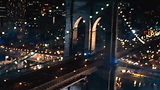
Helicopter shot of the East River showing the enormous scale of the scene.

The final cut scene in the film runs just under 4 minutes, but with a production like described above, this scene alone costed an impressive $5 million. Production Manager Paul Kramer about the scene: "The physical scale of the Brooklyn Bridge scene was the most daunting. There were so many moving parts. Just finding out who you needed the permits from and who needs to sign off was a job."
New York Mayor's Office of Film, Theatre, and Broadcasting called it "The biggest project ever to be filmed in New York City."
While the shoot of the scene took 6 nights, the production team has spent weeks to set up the lights on the Brooklyn Bridge. This included hanging lights from catwalks, positioning lights from both shores, and focusing powerful 2,500 lb. electric lamps (known in Hollywood as Klieg lights).
And then there was safety, which included the participation of NYPD divers and officers, conducting tests for helicopter landings and sound levels, positioning fire department trucks on shore, and obtaining assurance from the Coast Guard that maritime operations remained unaffected.
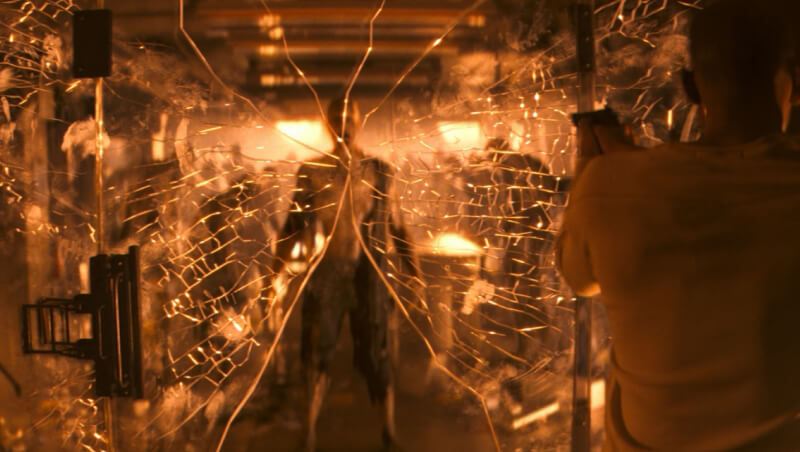
Neville's bullet cracks the window in the shape of a butterfly.
In the top right, the shape of a butterfly is missing from a poster.


Examples like the above shows how subtle references to butterflies were hidden throughout the film. As butterflies are delicate, their presence in a post apocalyptic environment can be interpreted as symbols for resilience. Their colorful, vibrant appearance create a stark contrast in decaying city, which creates a symbol of hope. And finally, the transformational process from caterpillar to to butterflies represents rebirth.
0:03:50
The length of the Brooklyn Bridge evacuation scene.
$21739
Costs per second for the Brooklyn Bridge evacuation scene.

Neville's and his loyal friend Sam are hiding from the infected.
The most terrifying monsters of I Am Legend are losing loved ones and urban isolation

Robert (Will Smith) and his dog Sam in a car scene.

Robert and Sam witnessing infected creatures.


I Am Legend

ETERNAL SUNSHINE OF THE SPOTLESS MIND
2004
Highlighted film
In a purposely vague New York, Charlie Kaufman and Michel Gondry, tell a unique and imaginative story that blurs the lines between memory, reality, and emotion. The narrative unfolds around the end of a relationship, but addresses the desire to escape reality and erase trauma, echoing the desires of many New Yorkers in the aftermath of recent events.
Besides New York City, many parts of the film were filmed in Montauk and the train that connects the locations. The choice for this location in addition to the city is clever, as Montauk's distance from NYC underscores the contrast between the fast-paced, impersonal city and the slower, more intimate seaside town. For many New Yorkers, Montauk is a place to escape their every day reality, which fits the premises of Eternal Sunshine Of The Spotless Mind:
After their breakup, Joel (Jim Carrey) discovers Clementine (Kate Winslet) has undergone a professional memory-erasing procedure to erase memories of Joel. Joel decides to undergo the procedure as well to escape his reality of pain. As his memories of Clem are gradually erased, Joel experiences them in reverse order, leading him to reconsider his decision.
The themes of memories, escape, relationships are explored in a highly inventive form of storytelling (written by Charlie Kaufman), which couples a narratives in a non-linear order with Michel Gondry's distinctive visual style, making it such an intriguing piece that the film has become an escape in itself
Joel starts the procedure of erasing his memory.

Inside a memory which is actively being erased as we watch. (Note that the labels of the books in the background have already been erased in this shot).

CLEM'S HAIR REFLECTS TIME AND THE STATE OF THE RELATIONSHIP



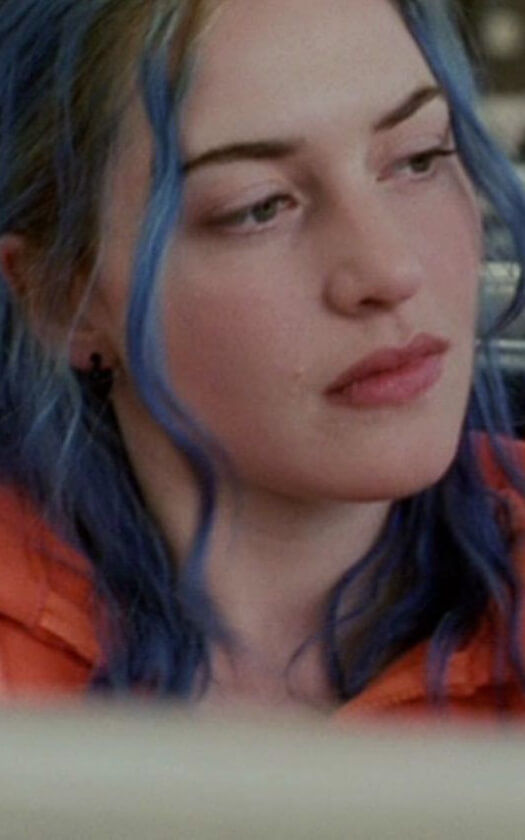
Spring
Beginning of the relationship
Summer
Halfway the relationship
Fall
Ending of the relationship
Winter
After the relationship
Clementine's hair goes through several colors in the film: green, red, orange and blue. These changes occur in different scenes seem to not follow a chronological order.
Each color seems to reflect a different time and various stages of her relationship with Joel. The nonlinear appearance of Clem's hair colors aligns with the film's narrative the moves through realtime events and memory. While the colors are open for interpretation, they can be seen as a visual aid to take us through the story, which I will lay out below.
THE STORY MOVES NON-LINEAR THROUGH REAL-TIME AND MEMORY
The film narrative we see events that happen in real-time and events that happen in Joel's memory. Real-time events happen in normal order (chronological). But events that happen in Joel's memory are in reverse order. This is because the memory erasing process moves its way back, starting from the most recent events.
Start with events in REALTIME (events in chronological order)

Clem and Joel meet for the first time (on a train).
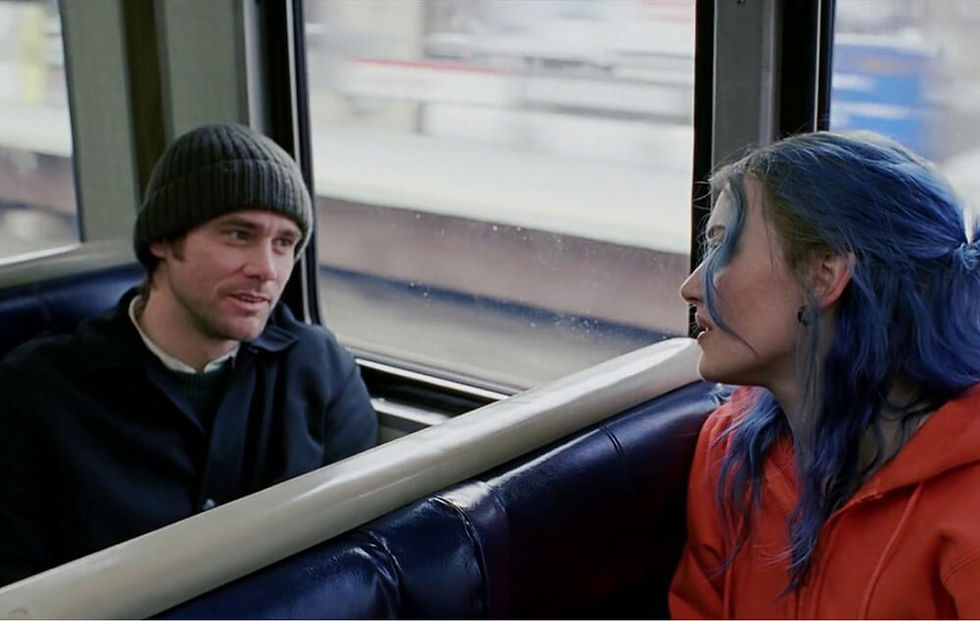
Joel goes to Clem's apartment.
Joel and Clem lay down on a frozen lake.
Clem and Joel's relationship is over (post break up).
Joel remembers having already started the process of erasing his memories of Clem.
Joel sees Clem in the bookstore, she doesn't remember him.
Joel finds out Clem erased her memories of him.
Joel goes through his memories of the relationship with Clem (order of events still reversed)

Clem leaves Joel (the break up)
Joel tries to follow and stop Clem from leaving in a dark street.
Joel and Clem spend time at Joel's apartment.
Clem and Joel walk through Lower East street during argument.
Joel and Clem's sad dinner at a restaurant.


Joel resists memory erasing during frozen lake and Grand Central Station memories.
Joel mixes memories of him as a child with those of Clem.
Joel finds Clem in the bookstore where she works.
Memory of seeing elephant parade together on Times Square.

Clem and Joel meet for the first time (Montauk Beach).

They spent the day together until there is no more memory left.
They decide to continue the relationship, knowing that their memories have been erased and the relationship might fail
They continue relationship after having met for the first time on a train (beginning of film)
Both find out they had a history, but it had been erased

Film Switches to Joel's memories to erase (events in reversed order)
Scenes of memories come by in reversed order of what happened

End of Joel's memories (memories erased)
Film goes back to realtime events (chronological order)

THE IN-CAMERA MAGIC OF MICHEL GONDRY
Gondry, who gained mainstream popularity in the 2000's, is known for his distinctive use of practical, in-camera effects. His trademarks contain optical illusions where he plays with time and space, hand made visual attributes and clever editing techniques. Gondry initially gained his popularity by applying these techniques to music videos for artists such as Björk, The Chemical Brothers, Daft Punk and many more.


Magic effect example: The dark, mirrored street in Joel's memory
In the film's early scenes, Joel recalls chasing after Clem, but his lack of control over his memories introduces dream-like elements. In a peculiar instance, he exits his car to pursue Clem on a street, only to find himself magically back at the street's 'beginning' each time he runs after her.


The effect was created by filming Jim Carrey twice, running both sides of the street. After that, one of the takes was flipped to make it seem like he is running the opposite direction, but in fact runs back to the car. A few parts of rotoscoping were added to make the transition between the two takes seamless in final film.
Take one – at the beginning of the street, Joel exits the car to run through the street.

Take two (mirrored in edit) – after running through the street, Joel magically ends up at his car on the same corner.

UlTIMATELY, A FILM ABOUT THE UNIVERSAL DESIRE TO ESCAPE REALITY

Joel's memories blend reality with dream-like scenes.
The film is packed with intriguing, complex narratives and straightforward visual effects that are appealing to experience and never age. Ultimately Gondry uses these storytelling mechanisms to delve into the universal human desire to reset, forget, and escape. This resonates with New Yorkers who struggle with the intense, overwhelming dynamics of life in the city, especially in light of the recent tragedy.
But what makes this film truly timeless, is that the core concept of erasing memory is wrapped up in the eternal theme of love. A theme that survives regardless of challenges and transformations around us.
Montauk Beach
The beach where Joel and Clem meet for the first time.
Grand Central Station
Station in Joel's memory where Clem is being pulled away from him.
Eternal Sunshine of the Spotless Mind
Other notable films 2000 – 2009
2000
Requiem for a Dream
A haunting portrayal of addiction and psychological decline in Brooklyn, showing the darker undercurrents of ambition and desperation in NYC life.
IMDb
2004
Spiderman 2
Captures New York as both backdrop and character—a vibrant, anxious, and heroic city at a time when post-9/11 optimism and caution still shaped daily life.
IMDb
2005
The Squid and the Whale
Set in 1980s Brooklyn but deeply relevant in the 2000s, this semi-autobiographical drama reflects the anxieties of intellectual New York families during a time of cultural transition.
IMDb
2006
Inside Man
A slick heist thriller set in a Manhattan bank, capturing the city’s financial paranoia, security obsessions, and class divides of the post-9/11 world.
2007
August Rush
A romanticized version of early 2000s NYC from the perspective of a musical prodigy, showing Central Park, Washington Square Park, and the city as a place of discovery.
2008
New York, I love you
An anthology of stories set across NYC boroughs in real time — love, loneliness, and chance encounters in a rapidly evolving city.
2008
Synecdoche, New York
A surreal psychological portrait of a theater director in Schenectady and NYC, dealing with anxiety, aging, and the collapse of reality in an increasingly chaotic cultural landscape.
2009
Whatever Works
Woody Allen’s return to New York filmmaking, reflecting the cynicism and quirks of urban intellectual life in a city at the tail end of a turbulent decade.
2009
Staten Island (Little New York)
A darkly comic crime film starring Ethan Hawke, set entirely in Staten Island, examining small‑town parochialism and criminal morals on the borough fringes.
1990
Goodfellas
The story of Henry Hill and his life in the mafia, covering his relationship with his wife and mob partners.
1981
Escape from New York
In 1997, when the U.S. president crashes into Manhattan, now a giant maximum security prison, a convicted bank robber is sent in to rescue him.
1990
Ghost
After a young man is murdered, his spirit stays behind to warn his lover of danger, with the help of a psychic
1992
Scent of a Woman
A prep school student needing money agrees to "babysit" a blind man, but the job is not at all what he anticipated.
1992
Home Alone 2: Lost in New York
Kevin McCallister accidentally finds himself stranded in New York City - and last year's criminals are not far behind.
IMDb
1993
Six Degrees of Separation
An affluent NYC couple finds their lives touched by a mysterious young black man who is never quite who he says he is.
1993
A Bronx Tale
Intense drama about a boy torn between his tough, hard-working father and a violent yet charismatic crime boss.
1994
Crooklyn
Spike Lee's semi-autobiographical portrait of a school teacher, her stubborn musician husband and their kids living in Brooklyn in 1973.
1995
Rumble In The Bronx
A young man visiting and helping his uncle in New York City finds himself forced to fight a street gang and the mob with his martial art skills.
1997
The Devil's Advocate
An exceptionally-adept lawyer is offered a job at a high-end NYC law firm with a high-end boss--the biggest opportunity of his career to date.
1997
Donnie Brasco
An FBI undercover agent infiltrates the mob and finds himself identifying more with the Mafia life--at the expense of his regular one.
1997
As Good as It Gets
A single mother and waitress, an author, and an artist form an unlikely friendship after the artist is assaulted in a robbery.
1988
You've Got Mail
Businessman Joe Fox, and Kathleen Kelly, an independent bookstore owner, fall in love online while he unknowingly aims to put her shop out of business.
1989
Being John Malkovich
A puppeteer discovers a portal that leads literally into the head of movie star John Malkovich.
1970 – 1980
A WAVE OF ANARCHY
With a fiscal crisis at its peak, crime took over in NYC. This breakdown of social order inspired filmmakers to make grittier films.
In response to near bankruptcy, New York City embraced lawless capitalism for better and for worse.
1980 – 1990
RAGING GROWTH
1990 – 1999
GRIT TO GLAMOUR
Declining crime rates and steady economic growth. The city shifted from being notorious for crime to a global city of commercialization and culture.
2000 – 2009
REBIRTH
After the 9/11 attacks, New York City experienced a strong recovery, leading to gentrification in neighborhoods beyond Manhattan.
2010 – 2019
URBAN ELEVATION
Globalization and the rise of tech startups shaped New York City into a hub of 'hustle culture' and a modernized urban landscape
2025 – 2030
FUTURE YEARS
The filmic future of NYC, envisioned through Gen-AI -amplified research, exploring projected trends and the city’s evolution for the years to come