

THE RAGING GROWTH THAT SPLIT THE CITY FOR BETTER AND WORSE
As the city rebounded from near bankruptcy in the 70s, it aggressively embraced change for survival. Deregulation and tax incentives revitalized the market, sparking the first budget surpluses for the city in decades. But, this mainly favored wealthy traders to help them grow even more while drastically worsening the city's existing class divide.
Wall Street, Manhattan
Street in the city's financial district that has become symbol for the US economy in film and other media.
Upper West Side
Considered 'Uptown' for New Yorkers (along with Midtown and Upper East Side); a Manhattan area that has benefited the most from the economic growth.
Cover photo: Wall Street (1987)
While the city council looked away as it was still counting its gigantic income, the consequences of free, lawless capitalism affected the city eventually. The city's new earnings looked bright for the city's future, but didn't mean much change for public housing or social programs. Instead, the new funds went to "quality of life" which included tourism, corporations and polishing up uptown shopping streets. As Oliver Stone, the director of the 1987 film Wall Street pointed out “Reagan was a tonic, but we didn’t know what he was doing underneath the surface when he was stripping the middle class economy out. We didn’t recognize that.”

Dan Aykroyd and Eddie Murphy trade being poor and rich in Trading Places (1983).
Charlie Sheen as a young stock broker in Wall Street (1987).

Due to drastic changes led by US President Reagan and New York Mayor Koch, Wall Street became the booming financial center of the world. This period saw the rise of risky "junk bonds," hostile takeovers, and enormous profits, giving birth to a new form of crime; financial crimes. It became a time where many aggressive traders engaged in illegal activities, but it was simply paying off a bit too well for the city to charge traders. In fact, the enormous volume of money that freely moved around, meant the longest period of growth in American History until the 1987 stock market crash (Black Monday). This crash, caused by irresponsible trading, did prompt trading reforms but still didn’t affect the broader societal and financial disparities.
A BITTERSWEET ERA THAT HAS SET THE CITY'S FUTURE TRAJECTORY

A source for film inspiration
NEW YORK'S CREATIVE BOOM AMIDST ECONOMIC DISPARITIES
With the increased economical differences and ongoing social issues, more differences between neighborhoods and communities started to emerge. The significant growth and change of the city created a golden era for New York’s music, art and film scenes. This rise of Hip-Hop, Punk, New Wave, numerous art galleries in East Village and the start of new independent cinema movements were used to share New York’s vibrant culture to the world.
As the streets in uptown Manhattan were being polished to attract tourism and upscale businesses, rising property value triggered gentrification, starting in upper Manhattan. This led to urban renewal to other neighborhoods like SoHo and East Village which opened possibilities for artists. Notable artists like Andy Warhol and Keith Haring made significant marks on street art, while bands like The Velvet Underground and The Ramones helped Punk culture emerge through the city and the broader world. Concurrently, across the city more art forms including the early iterations of Hip-Hop flourished.


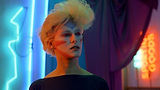
Within the intersection of low-fidelity and low budget art productions, short lived film movements such as “No Wave Cinema” and “Cinema of Transgression” began. The films from these movements felt anything but professional, but brought remarkable new creative energy to the screen. Examples are Liquid Sky (1982), which blends the scenes of fashion, modeling, dance and drugs. Stranger Than Paradise (1984) and Spike Lee’s She’s Gotta Have It (1986). These all laid the foundation for the indie film explosion the following decades.
SoHo, Manhattan
Neighborhood south from the "expensive" uptown area which was known for fostering fashion designers, visual artists and trendy stores.
East Village, Manhattan
South from uptown area. Known for its art galleries and music scene.
1980 – 1989
80's hits


80's hits


1970 – 1980

$100
Super 8mm cameras could be bought for as low as $100
01
The compact, all in one video camera only required one camera operator to point and shoot
With the city cleanup, the demand rose for filming locations. And since the film industry was still a serious earning for the city, the federal government began to take over studios and boost funding for film shooting in the city more than ever before. With this new fundings, films like Ghostbusters (1984), Once Upon a Time in America (1985) and Coming To America (1988) marked impactful big-scale filmmaking, posing new challenges for budget-conscious creators.

1980
Permanent Vacation
Jim Jarmusch's debut feature film explores the life of a young man wandering through New York City, reflecting the disaffected youth of the era.
Battery Park, Manhattan
1982
Vortex
An experimental film that blends narrative and documentary elements. It uses Super 8mm to capture the urban environment and counterculture scene of 1980s New York.
1983
The Foreigner
Directed by Amos Poe, this film is another example of the No Wave cinema movement of the early 1980s. It offers a gritty and experimental portrayal of New York City.
East Village, New York
1984
Stranger Than Paradise
This indie, minimalist, deadpan film by Jim Jarmusch follows the story of two friends and an immigrant relative as they navigate life in New York City.

1986
She's Gotta Have it
Spike Lee's breakout film was partially shot using Super 8mm cameras. The film explores the romantic life of a young woman in Brooklyn.
Fort Greene Park, Brooklyn

1989
Do The Right Thing
This film tells a story about a Brooklyn neighborhood with racial tensions. Spike Lee used the Super 8mm to show a "memory wall" of people who had died because of racial violence.
Stuyvesant Avenue, Brooklyn (Do The Right Thing Way)
When film-maker Spike Lee found himself without a job in the late 70s, he decided to go to his friend’s house and stumbled upon a Super 8MM camera that was given to his friend. After asking about it, the camera was given to Lee. With the turbulent events happening in the city at the time, Lee started to capture the social crisis on the streets with his “point and shoot” video camera. By the end of the school year, he decided to become a film major. "I still haven't asked her who gave her that camera." Lee said. "Think about it, all these things had to happen. So it's not a mistake I became a film-maker".
After his studies, Spike Lee created his first films in the 80s. His 1986 breakout film She Gotta Have It was partially shot using a Super 8mm camera. The successful low budget film explores the romantic life of a young woman in Brooklyn. And later in 1989, Lee used the Super 8mm camera again in the iconic film Do The Right Thing. In this Brooklyn based film he used the camera's footage to create a “memory wall” that shows portraits of people who had died because of racial violence. This creative use of the Super 8mm was meant to emphasize the impact of racial tensions on the community.
Just like Spike Lee, other film-makers such as Jim Jarmusch and Amos Poe found their way to the Super 8mm camera to tell stories that stood out amidst expensive Hollywood style productions in the 80s.
SUPER 8MM,
NEW YORK'S WEAPON AGAINST BIG BUDGET FILMS
Notable films using the Super 8MM camera in 80s New York
1980
Permanent Vacation
Jim Jarmusch's debut film: Explores the life of a young man wandering through NYC, reflecting the disaffected youth of the era.
Battery Park, Manhattan
1982
Vortex
An experimental film that blends narrative and documentary elements. It uses Super 8mm to capture the urban environment and counterculture scene of 1980s New York.

1983
The Foreigner
A No Wave film By Amos Poe. Offering a gritty and experimental portrayal of New York City.

1976
Stranger Than Paradise
Indie film by Jarmusch follows the story of two friends and an immigrant relative as they navigate life in NYC.
1986
She's Gotta Have it
Spike Lee's film about the life of a young woman in Brooklyn. Partially shot on Super 8mm.

1989
Do The Right Thing
Spike Lee used the Super 8mm to show a "memory wall" of people who had died because of racial violence.

1980 – 1989


1987
Highlighted film
WALL STREET


New York Stock Exchange
New York's stock exchange floors as depicted in the film. Located in the Financial District, Manhattan
Gordon Gekko's office
Filming location of Gordon's office, above what is now a mall in lower Manhattan.
What Stone had successfully accomplished was the creation of a character that encapsulated the essence of finance and trading during this pivotal era on Wall Street. Gordon Gekko was partly inspired by several real-life figures, including Ivan Boesky and Michael Milken, who were prominent figures in the financial world during the 1980s. Both of them were engaged in financial crimes. Boesky was a key player in insider trading (using non-public information for the benefit of successful trading). While Milken was known for his high-yield bond dealings which were highly transformative for for corporate finance and earned him the name of "Junk Bond King".
Released in December 1987, right after Black Monday, the largest single-day stock market crash in US history. The film depicts Gordon Gekko and his protege as ruthless traders who embody 80s Wall Street. While this greed fueled the city's economic boom, it was the exact same thing that caused Black Monday which forced a clean up on Wall Street.
"We don't really know what a stockholder is.", says Oliver Stone, the director of the film. "We talk about it but don't actually know what it looks like. So we actually researched it and we staged Roosevelt Hotel so we would get a feeling of what they're actually doing."
To research details for his film, Stone visited stock floors to delve into the jargon and technology. He met with actual Wall Street power brokers whose lives he discovered were filled with the excesses. Consultants such as former deputy mayor Ken Lipper and David Brown, a broker convicted of insider trading, lent the details.
The details learned would eventually be depicted in Wall Street, in which a young, broker believes he can work his way up rapid, big money by getting closer to Gordon Gekko, a known Wall Street giant. He would do whatever it takes to get to fast results to the liking of Gekko. This includes following Gecko's leads in committing financial crimes such as insider trading. Gecko sees no harm in his actions, because everyone is doing it. "We make the rules...It's the free market. And you're a part of it."
DEPICTING WALL STREET TRADING FLOORS AS REAL AS IT GETS
GREED, FOR A LACK OF A BETTER WORD, IS GOOD. UNTILL IT'S NOT.
Most of the trading floor scenes were filmed in an office on 222 Broadway, Manhattan (above what is now Fulton Center). Stone and the team staged the indoor locations to mimic the look and feel of the Wall Street trading floors. This included real stock brokers as extras and accurate depictions of the hardware such as the trading terminals of the time (computers with screens to calculate and display real time financial data). The scrolling stock market information seen in the film's trading scenes were also accurate for the time. In addition, Stone even managed to get permits to shoot for a few hours on the floor of the New York Stock Exchange.
Other than Stone and the production team who went great lengths to make the film authentic, actor Charlie Sheen who played the film's protagonist Bud Fox, spent time at a brokerage firm to prepare for his role. He even managed to secure a real broker's license during this process.
Charlie Sheen on the staged trading floor.

The staged trading floor was accurately set up with Quotron trading terminals.


$100M
Boesky was sentenced to a $100M fine and 2 years of jail for financial crimes
$600M
Milken was sentenced to a $600M fine and 10 years of jail for financial crimes
Ivan Boesky arrested in 1987 for insider trading with non public information.

Michael "Junk Bond King" Milken arrested for crimes related to securities fraud and racketeering.

Black Monday triggered investigations on the Wall Street floors, to prevent such catastrophic crashes from ever happening again. And with that Boesky and Milken were both convicted for their crimes: Boesky settled for a fine of $100M and two years of jail. Milken was sentenced to a $600M fine and 10 years of jail. (all though he only served for 2 years due to good behavior).
Michael Douglas played the role of Gordon Gekko, the iconic and ruthless Wall Street trader. His character's famous "Greed is good" speech became a defining moment in the film. Even to this day, the speech has had a lasting impact on pop culture and is often quoted in discussions and education about finance and ethics.

A sobering window into the real world of financial crimes
Bud questioning Gordon's morals.
With the characters in Wall Street, Oliver Stone helped us to get a good idea to the original question that started the writing process: What actually is a Wall Street stock broker? The film shows a New York that has welcomed a new form of crime that transformed the streets. It also accurately depicts the consequences of lawless money controlled by greedy individuals. The events following Black Monday contributed to drastic changes in the legal system against financial misconduct. But the timely release of Wall Street helped ethical conversations around complex financial concepts.

Bud Fox (Charlie Sheen) meets his mentor, Gordon Gekko (Michael Douglas)
Wall Street

1989
Highlighted film
DO THE RIGHT THING

WALL STREET
1987
Highlighted film
Watch
IMDb
Spotify

GHOSTBUSTERS
1984
Highlighted film
Watch
IMDb
Spotify

DO THE RIGHT THING
1989
Highlighted film
Watch
IMDb
Spotify
Shot entirely on a single block in Bed-Stuy. The film shows a single-day story in a Brooklyn street during the hottest day of the year. But it's not just weather that becomes unbearable, as Do The Right Thing tells the story of boiling racial tensions that reached new heights due to the city's transformation.

Buggin' Out and Mookie in discussion in the shade.

Raheem (Bill Nunn) blasting his Boombox in the shade.
It's hard to imagine, but as pre-production neared its conclusion, Paramount executives delivered a shocking ultimatum to Spike Lee, insisting on an overly optimistic ending. "They wanted Mookie and Sal to hug, become friends, and sing 'We Are the World.'" Lee mentioned in an interview with New York Magazine, and he didn't hesitate. "They informed me on a Friday, and by Monday morning, we had moved to Universal." Clearly, he made the right decision.
Spike Lee's film had a significant impact on the city of New York, both culturally and socially. It sparked conversations about gentrification, race, prejudice, and police-community relations in the city. It also represented the diverse, vibrant cultures of New York's neighborhoods that are not just in uptown Manhattan and inspired other film makers to explore deeper topics in the city. Throughout the decades, the film continued to have a lasting impact on New York City and beyond as its still highly relevant in today's discussions around racial and social issues.


Mookie and Sal arguing in the final scenes of the film.


The biggest challenge was shooting the film over eight weeks and making it look like one single day. For this reason Spike Lee and cinematographer Ernest R. Dickerson looked for a street that ran north-south. Since the sun moves from east to west, there would be always one side of the street in the shade.
That way, when they had to shoot on cloudy days, they could just make it look like they were on the shaded side of the street. "That really saved us, because the first two weeks we had a lot of rain. Some shots where it looks sunny – you can actually see rain if you look really hard." said Dickerson.
Opening with the sounds of Public Enemy's "Fight the Power" while one of the characters of the Stuyvesant Avenue story creates an explosive dancing scene. Do The Right Thing had one of the most distinctive openings which set the tone and attitude for a new type of film that, despite initial negative criticism became one of the most praised films of the 80s.
Director Spike Lee portrays Mookie, the central character in the film, and a delivery person for Sal's Famous Pizzeria.While he experiences some racial tensions with Sal's son Pin (John Turturro), the real tensions don't start to rise until Mookie's friend Buggin' Out (Giancarlo Esposito) makes a comment about the framed photos on the wall of Sal's restaurant. They are all photographs of prominent American-Italian figures. Mookie's friend confronts Sal about the lack of "brothers on the wall", because he observes that most of the customers are African-American.
With the tensions rising throughout the film, Lee refused to stack the deck. He managed to write scenarios (like the photo frame example above) in which both points can be seen as valid. These type of complex conflicts rooted in culture and economic differences make a story for a film that is as relevant today as it was during its release in 1989.
08
Eight weeks of shooting for the single day story
04
4 hours duration for the original cut (cut down to 2 hours)
225
Mentions of the word "Fuck" ended up in the final cut
THEY WANTED MOOKIE AND SAL TO HUG AND BE FRIENDS

Do The Right Thing Way, Brooklyn
Block in which the film was recorded
Mister Dragonette
Creator of the stunning Love / Hate pin
MAKING A FILM LOOK LIKE ONE HOT DAY, MEANS PLANNING FOR THE SUN

The film doesn't go outside of the block, which is now officially called the 'Do The Right Thing Way'. That means that all the actors of the film were there every day. Spike Lee is known for hiring actors for the length of the entire film, rather than only for the duration of their parts. This allowed for greater consistency as characters living in the street could be seen in backgrounds as well. For instance, when looking through the window from Sal's, you would always see the Korean shop owners across the street. Or when passing by stoops in front of houses, you would see familiar faces.
Spike Lee directed the film and starred in it as "Mookie".
The block on Stuyvesant Avenue is now officially called "Do The Right Thing Way".
HOWARD BEACH AND COUNTLESS OTHER EXAMPLES OF RACIAL TENSION
With a disproportionate lack of support for minority communities in the city's "booming" 80’s, racial tensions started to rise. It created complex, multifaceted issues in gentrification, education, politics, police relations and even health care while New York was suffering from the AIDS/HIV epidemic. Do The Right Thing was directly inspired by issues like these. Specifically, Lee was motivated to create the film after the Howard Beach racial attack of 1986.
During this event, four young Black men, stranded in a predominantly white neighborhood due to a car breakdown. They encountered racial slurs from local residents in the Howard Beach neighborhood of Queens. As they left a local Pizzeria in search of a pay phone, tensions escalated, leading to a violent attack by white individuals wielding baseball bats. Tragically, one of the Black men was fatally struck by a vehicle while fleeing the scene.

Moments later, the police found one of the remaining Black men and neglected to offer immediate medical assistance to his injuries. Instead, they brought him back to his friend’s body, searched him thoroughly and conducted an hours-long interrogation at a police station. This incident was such a part of Do the Right Thing’s DNA that Lee wanted to open the film with his character, Mookie, shouting “Howard Beach!” while defacing Sal’s Famous Pizzeria.
Protesters demonstrating in reaction to the racial attack on Howard Beach.


Do The Right Thing

1984
Highlighted film
GHOSTBUSTERS
As demons and ghouls wreak havoc across New York City, the Ectomobile journeys through various neighborhoods of the metropolis. And while the film features fictional supernatural events, these rides offer a glimpse into the transformational vibrant energy of 1980s New York City.
After Dan Aykroyd wrote the first draft of Ghostbusters, inspired by his fascination for the paranormal, he shared it with Bill Murray. Murray enjoyed the 50 page draft script so much, that he shared it with director Ivan Reitman. But at that time, Reitman felt reluctant about the script as he had concerns about feasibility.
Aykroyd pushed forward and convinced Reitman by sending him a now complete 180 page script along with not only concept drawings, but also a videotape of himself wearing a jumpsuit based uniform and a makeshift Particle Thrower and a Proton Pack fashioned from styrofoam and old radio parts. In particular, Reitman enjoyed the idea of a group of men operating from a firehouse and responding to emergency calls like the Fire Department of New York would.
After adding Harold Ramis to help finalize the script, shooting began on what is now known as some of the most iconic NYC locations, such as the New York Public Library, Rockefeller Center and the Lincoln Center. On top of that, the production included ground breaking practical effects made from scratch to help visualize radiant ghosts around iconic city landmarks as an integral part of the film's visual storytelling.

Egon tracking the "library ghost", using a PKE meter.
The Ectomobile (Ecto-1) crossing the Manhattan Bridge.

TRACKING GHOSTLY SPOTS IN NEW YORK
New York Public Library
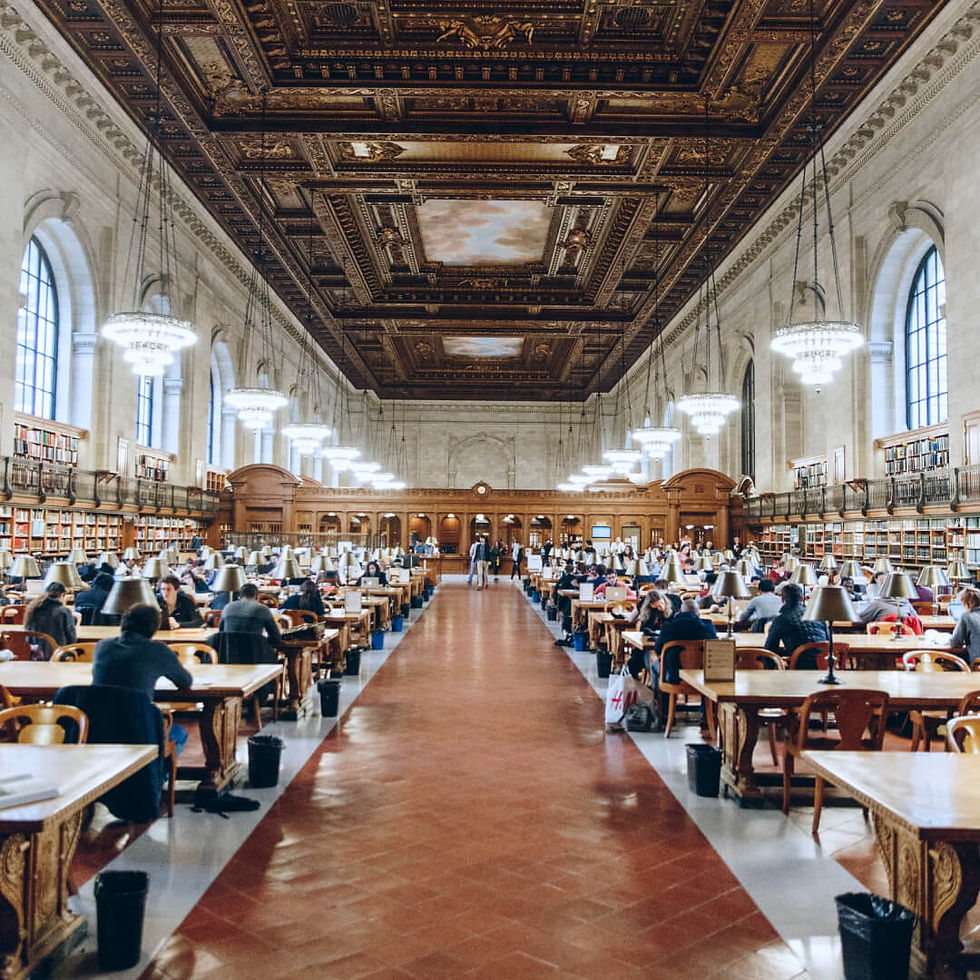
The film starts with paranormal activity at the famous institution, the Ghostbusters investigate using a PKE meter, and stumble upon the Librarian Ghost. You can visit the Rose Main Reading Room and, like Ray, walk down the stairs at the entrance (though you might not encounter as many pigeons since they were rented for the film.).

The New York Public Library
Library in Midtown, Manhattan. Frequently seen in films such as the Library Ghost in Ghostbusters.
The Lincoln Center
Dr. Peter Venkman (Bill Murray) encounters Dana Barrett (Sigourney Weaver) at the Lincoln Center. Note that the Lincoln Center's fountain design has changed since the film's production.
For the long shots at Lincoln Center, the crew had to loop dialogue because the fountain in the background created so much noise. For the closeups, when the fountain was out of frame, they had switched off the fountain.


The Lincoln Center for the Performing Arts
Complex of buildings for the performing arts in Upper West, Manhattan. The fountain stands in the middle of the complex.
Hook & Ladder #8
The most famous location in the film is undoubtedly the firehouse the Ghostbusters use as their office: Hook and Ladder #8, in Tribeca, Manhattan. The exterior has been used for its New York firehouse feeling while the interior parts have been filmed elsewhere. Today, you can still visit it in its original state, complete with the iconic Ghostbusters logo, making it a popular attraction for tourists.


FDNY Ladder 8
Actively used firehouse in Tribeca, Manhattan. Preserved in similair state as the film, including Ghostbusters logo.
A SURGE INTEREST IN THE GHOST HUNTING
Ghost hunting, as a paranormal hobby and interest, has a long history, and it was not unique to New York City during the 1980s. But, after the release of Ghostbusters and some notable events, the city did see a surge in interest in the paranormal, including ghost hunting.


SCARY GOOD BUSINESS, BOTH ON AS OFF SCREEN


$1B
On merchandise sales to date
$943M
Box office across 4 films
$82M
On home media to date
While Ghostbusters is a comedy with supernatural adventures, it indirectly touches on themes related to entrepreneurship, commercialization, and regulation (in a lighthearted way) which are relevant in the context of the capitalism environment of New York City in the 80s.
Apart from business in the story itself, Ghostbusters became a great commercial success. The original Ghostbusters made $295M in 1984. The studio (Columbia Pictures, now Sony), turned it into a franchise and gained $215M with the release of Ghostbusters II, 5 years later. Besides the sequel, Ghostbusters appeared in various other forms to leverage off its influence on pop culture. This varies from comics, animated series, costumes, figurines and other merchandise.

Hook & Ladder #8
The Ghostbusters firehouse
The New York Public Library
Location where you might be able to find the Librarian Ghost

Ghostbusters
Other notable films 1980 – 1989
1980
Raging Bull
The life of boxer Jake LaMotta, whose violence and temper that led him to the top in the ring destroyed his life outside of it.
IMDb
1981
Escape from New York
In 1997, when the U.S. president crashes into Manhattan, now a giant maximum security prison, a convicted bank robber is sent in to rescue him.
IMDb
1983
Trading Places
A snobbish investor and a wily street con artist find their positions reversed as part of a bet by two callous millionaires.
IMDb
1985
After Hours
An ordinary word processor has the worst night of his life after he agrees to visit a girl in Soho he met that evening at a coffee shop.
1988
Big
After wishing to be made big, a teenage boy wakes the next morning to find himself mysteriously in the body of an adult.
1988
Coming to America
An extremely pampered African prince travels to Queens, New York and goes undercover to find a wife that he can respect for her intelligence and strong will.
1989
When Harry Met Sally
Harry and Sally have known each other for years, and are very good friends, but they fear sex would ruin the friendship.
1980
Raging Bull
The life of boxer Jake LaMotta, whose violence and temper that led him to the top in the ring destroyed his life outside of it.
1981
Escape from New York
In 1997, when the U.S. president crashes into Manhattan, now a giant maximum security prison, a convicted bank robber is sent in to rescue him.
1983
Trading Places
A snobbish investor and a wily street con artist find their positions reversed as part of a bet by two callous millionaires.
1985
After Hours
An ordinary word processor has the worst night of his life after he agrees to visit a girl in Soho he met that evening at a coffee shop.
1988
Big
After wishing to be made big, a teenage boy wakes the next morning to find himself mysteriously in the body of an adult.
IMDb
1988
Coming to America
An extremely pampered African prince travels to Queens, New York and goes undercover to find a wife that he can respect for her intelligence and strong will.
IMDb
1989
When Harry Met Sally
Harry and Sally have known each other for years, and are very good friends, but they fear sex would ruin the friendship.
IMDb
1970 – 1980
A WAVE OF ANARCHY
With a fiscal crisis around the corner, high unemployment and wealthy people escaping the city, there was a breakdown of social order in NYC
With a fiscal crisis around the corner, high unemployment and wealthy people escaping the city, there was a breakdown of social order in NYC
1980 – 1990
NEW BEGINNINGS
1990 – 2000
CULTURAL RENAISSANCE
With a fiscal crisis around the corner, high unemployment and wealthy people escaping the city, there was a breakdown of social order in NYC
2000 – 2009
CHALLENGE AND TRANSFORMATION
With a fiscal crisis around the corner, high unemployment and wealthy people escaping the city, there was a breakdown of social order in NYC
2010 – 2019
A GROWING CITY
With a fiscal crisis around the corner, high unemployment and wealthy people escaping the city, there was a breakdown of social order in NYC
2025 – 2030
FUTURE YEARS
The filmic future of NYC, envisioned through Gen-AI -amplified research, exploring projected trends and the city’s evolution for the years to come